Yellowjacket, paper wasp, and hornet nests require immediate professional removal — stings cause hundreds of anaphylactic deaths in the US annually. Honey bees are protected pollinators we remove live and relocate wherever possible. Licensed. Safe. Guaranteed Fast Response.
Stinging insect nests on your property represent a serious and escalating risk — both to your family and to anyone who unknowingly disturbs the colony. Here's what's at stake.
Approximately 500,000 Americans visit emergency rooms annually due to stinging insect attacks, and around 220 die from anaphylactic reactions — more than from any venomous animal. One in 50 adults has a venom allergy severe enough to cause anaphylaxis — and many don't know until their first reaction. Households with children, pets, or outdoor workers face compounded exposure risk from an active nest.
Yellowjackets and hornets do not lose their stinger after stinging — each individual can sting repeatedly and release alarm pheromones that recruit hundreds more defenders instantly. A colony disturbed during lawn mowing, trimming, or even walking near a nest entrance can produce a mass stinging event within seconds. Underground nests — common in Northern California — are particularly dangerous because the entrance is not visible until it's disturbed.
A queen starts a yellowjacket colony alone in spring — by August, that colony contains 5,000–500,000 workers. A paper wasp nest found under an eave in May with 10 cells will have 200–300 workers by September. Every week of delay means a significantly larger, more aggressive, and more dangerous colony. Late summer and early fall are the most dangerous period — colonies are at peak size and food scarcity makes them highly defensive.
Correct identification is essential — especially distinguishing honey bees (protected pollinators we relocate live) from yellowjackets and wasps (which require removal). Never treat a honey bee colony as a wasp problem.
Yellowjackets are the most dangerous stinging insect we handle — aggressive, fast, and capable of stinging repeatedly without losing their stinger. They build large nests both aerially (under eaves, in wall voids) and underground — often in abandoned rodent burrows. Underground yellowjacket nests are particularly hazardous because they are invisible until disturbed, typically by a lawn mower or footstep near the entrance.
Paper wasps build the distinctive open-celled umbrella-shaped nests visible under eaves, railings, door frames, shutters, and outdoor furniture across all our service areas. They are less aggressive than yellowjackets when unprovoked, but will sting repeatedly when the nest is disturbed — and nests in high-traffic areas create a near-constant exposure risk. Common throughout all of Lake, Mendocino, and Sonoma Counties.
Bald-faced hornets build large, grey, papery aerial nests — most often in trees, shrubs, and under eaves — that can reach football size by late summer. They are significantly more aggressive than paper wasps and will pursue perceived threats considerable distances from the nest. Their size and the alarm pheromone response of their colony make a disturbed hornet nest one of the most dangerous stinging insect scenarios we encounter.
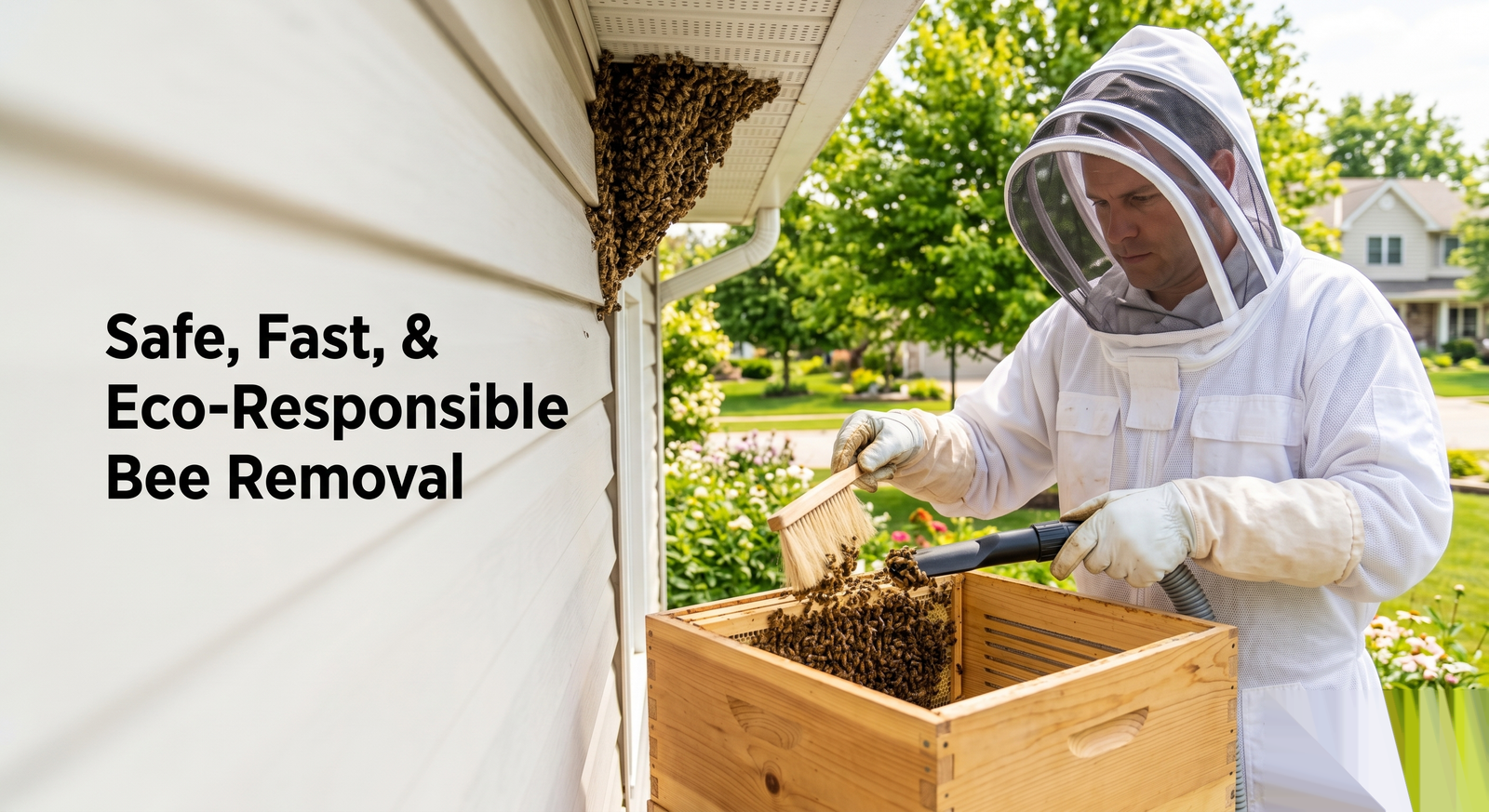
Honey bees are ecologically essential pollinators — we never exterminate them when live relocation is possible. A swarm of honey bees (a temporary cluster of bees looking for a new home) is docile and can usually be collected by a local beekeeper at no charge. An established colony inside a wall void, eave, or structure requires removal of the comb as well as the bees — leaving honeycomb behind attracts new swarms and can cause structural damage from honey melting in summer heat.
Carpenter bees bore perfectly round 12mm holes into untreated wood — fascia boards, decking, siding, fences, and wooden railings — to create nesting galleries. While a single carpenter bee causes minor damage, the same holes are reused and expanded over multiple seasons, and woodpeckers excavating for carpenter bee larvae significantly amplify the structural damage. Common throughout all our service areas in unpainted or weathered wood structures.
Several solitary and semi-social wasp and bee species nest in the ground throughout Northern California — including digger wasps, mud daubers, and ground-nesting bumble bees. Most ground-nesting species are docile and beneficial. However, yellowjacket ground nests (often in abandoned rodent burrows) are highly dangerous. Our technicians correctly identify ground-nesting species before recommending any treatment.
Northern California's wine country, orchards, and agricultural land depend on healthy pollinator populations. Honey bees are essential to that ecosystem — and to California's $50 billion agricultural economy. Our policy is relocation first, always.
A honey bee swarm is a temporary cluster of bees looking for a new home — they are docile (no comb to defend) and typically need a new location within 24–72 hours. We connect swarms with local Northern California beekeepers who collect them at no charge to the homeowner. Call us first — we assess whether it's a swarm or an established colony.
An established honey bee colony inside a wall void, eave, or structure requires more than bee removal — the entire comb must come out. Abandoned honeycomb melts in summer heat, attracting new swarms, ants, and other pests, and can cause structural water damage. We remove bees and comb together, then seal the void to prevent re-colonisation.
We work with local beekeepers across Lake, Mendocino, and Sonoma Counties — connecting relocated bee colonies with keepers who can continue their work as productive hives. Northern California's agricultural community depends on healthy local bee populations, and every colony we relocate rather than exterminate contributes to that ecosystem.
Nest locations vary significantly by species — and knowing where to check can help you identify a problem before it becomes dangerous. Never approach or disturb a suspected nest. Call us instead.
The single most common location for paper wasp and bald-faced hornet nests across all our service areas. Sheltered from rain, elevated for protection, and with a clear flight path — the underside of eaves is ideal wasp nesting habitat. Nests often go unnoticed under soffits, behind gutters, and inside eave vents until late summer when they are large enough to be visually obvious.
Yellowjackets commonly take over abandoned rodent burrows for underground nesting — creating the most dangerous nest scenario because the entrance is invisible until stepped on or mowed over. Common in lawns, garden beds, slopes, and around tree roots throughout rural Lake and Mendocino County properties. Any unexplained wasp activity at ground level warrants immediate inspection.
Bald-faced hornets and some yellowjacket species build large aerial nests in tree branches, dense shrubs, and thick hedgerows. These nests start small and hidden in spring, reaching football-to-basketball size by August. Summer pruning and hedge trimming frequently disturbs established hornet nests — the most common cause of severe mass-sting events we respond to.
Yellowjackets and honey bees both establish colonies inside wall voids, accessing through gaps in siding, around utility penetrations, and through vents. Wall void nests are among the most difficult to treat — and in the case of honey bees, require comb removal in addition to bee removal. A buzzing sound from inside a wall is the most common early indicator.
Rarely-used vehicles, garden machinery, BBQ grills, outdoor furniture, and stored equipment are common paper wasp nest sites — particularly in Lake and Mendocino County properties with outbuildings and equipment storage. Starting a seldom-used engine or opening storage near a nest without checking is a frequent cause of surprise stinging incidents.
Carpenter bees target exposed, unpainted wood in decking, railings, fence posts, and wooden structures — boring neat 12mm round entry holes. Paper wasps also frequently build under deck railings and attach nests to fence joints and corners. Deck and fence areas should be inspected annually in spring before they become actively occupied.
Every wasp and bee removal follows a structured process designed for safety, completeness, and prevention of re-nesting. We never just spray a nest and leave — we remove it.
We locate the nest and correctly identify the species before approaching — critical for choosing the right equipment and treatment. We assess colony size, access difficulty, and any secondary nests before advising on the removal approach. Never approach a suspected nest yourself while waiting for us.
If honey bees are identified, we assess whether the colony is a swarm (relocatable by a beekeeper) or an established colony. For swarms, we coordinate beekeeper collection. For established colonies, we plan full removal including comb extraction. For wasps and hornets, we proceed directly to treatment.
Our technicians wear full bee suits and protective equipment for all nest removals — no exceptions. Wasps are treated with fast-acting insecticide applied directly to the nest entrance and cavity, eliminating the colony before nest removal. For aerial nests, treatment is applied at night when the full colony is present and activity is minimal.
The entire nest structure is physically removed — not left in place. Leaving an abandoned nest, even after all occupants are dead, attracts new colonies the following season, provides shelter for other insects, and leaves unsightly debris. For wall void nests, we advise on the appropriate point of entry for comb extraction.
For wall void, eave vent, and structural nests, we seal the entry point after removal to prevent re-colonisation. Wasps leave pheromone traces at former nest sites that attract new queens the following spring — sealing the entry point removes access and significantly reduces the risk of a nest returning in the same location.
We advise on reducing future nesting conditions — sealing additional entry points, removing decayed wood, and reducing food attractants around outdoor dining areas. If wasps return to the treated location within 30 days, we return at no charge. Full satisfaction guarantee on every service.
Understanding wasp and bee colony development through the year helps you catch nests early — when they are small, manageable, and far less dangerous than a mature late-summer colony.
We distinguish carefully between harmful wasp species and beneficial bees. Our IPM approach prioritises live honey bee relocation over extermination, correctly identifies ground-nesting species before treating, and uses targeted treatment methods that minimise impact on surrounding beneficial insects. Northern California's agricultural and wine country ecosystem depends on healthy pollinator populations — and we take that responsibility seriously.
Every wasp and bee removal is performed in full protective equipment — no exceptions. We never approach an active nest without a proper bee suit. This is not optional and it is not something a homeowner should attempt without professional gear. Your safety and our technician's safety are the first priority in every removal.
We never exterminate honey bee colonies when live relocation is possible. We work with local Northern California beekeepers to ensure swarms and removable colonies continue as productive hives. This commitment is part of our broader responsibility to the agricultural ecosystems of Lake, Mendocino, and Sonoma Counties that we serve and are part of.
We physically remove the entire nest structure after treatment — never leaving it in place. An abandoned nest left after chemical treatment continues to attract new queens the following spring, drawn by residual pheromones. Complete removal is the only way to prevent re-nesting in the same location year after year.
Wasp and hornet nests near entry points, outdoor living areas, or children's play spaces are safety emergencies. With offices in Lakeport, Windsor, Ukiah, and Fort Bragg, we respond Fast response in most areas — call us before noon and we have a technician at your property that afternoon.
Identifying the difference between a honey bee swarm, an established honey bee colony, a yellowjacket nest, and a paper wasp nest requires experience — and the treatment approach differs completely for each. Our technicians correctly identify every species before recommending or performing any treatment. The right ID leads to the right result.
If wasps return to the treated location within 30 days of nest removal, we return and re-treat at no additional charge. Forager wasps returning to a removed nest location are expected for a few days — if activity establishes again after 30 days, we investigate whether a new nest is forming and address it completely.
Fast Response across Lake, Mendocino, and Sonoma Counties — with four local offices ensuring fast arrival wherever your nest is located.
Honey bees are fuzzy, rounded, and golden-brown — they carry pollen visible on their rear legs. Wasps (yellowjackets, paper wasps, hornets) are smooth, shiny, and typically narrower with a pinched waist. Honey bee swarms cluster in a ball on a branch or structure and are docile — they rarely sting unless physically grabbed. Wasps are more likely to sting when you simply walk near them. When in doubt, call us — we identify the species before any treatment.
We strongly advise against it — particularly for any large nest, underground nest, or nest near a building entry point. Agitating a large yellowjacket or hornet colony without proper protective equipment can trigger a mass stinging event within seconds. Even "wasp freeze" aerosols require you to approach within 2–3 metres of the nest. The risk is not proportionate to the cost savings. Call us — Fast Response is available across all service areas.
No — we physically remove the entire nest structure after treatment. This is critical: an abandoned nest left in place continues to attract new queens the following spring, drawn by pheromone residue in the nest material. Homeowners who have nests treated-but-not-removed find a new colony in the same location the following year. Complete nest removal is included in every wasp removal we perform.
Our policy is live relocation wherever possible. For swarms (temporary clusters), we coordinate coordinated collection by local Northern California beekeepers. For established colonies inside structures, removal requires extracting bees and comb — we work with beekeepers to rehome the colony live where the access and extraction allows. In rare cases where a colony is inaccessible or poses immediate safety risk, extermination may be necessary — but it is never our first option.
Do not approach, poke, spray, or disturb it. Note the approximate location and size, then move away calmly — sudden movements and vibrations trigger defensive response. Keep children and pets away from the area. Call us as soon as possible — Fast Response is available across all four office areas. If anyone has been stung and is showing signs of an allergic reaction (swelling beyond the sting site, difficulty breathing, hives), seek emergency medical care immediately.
Wasps leave pheromone traces in old nest material that attract new queens looking for nesting sites the following spring. If nests are treated-but-not-removed, or if the entry point into a wall void or eave void is not sealed, queens reliably return to the same site year after year. Complete nest removal combined with entry point sealing — which we include in every removal — breaks this cycle.
The main indicator is wasp activity at or near ground level — wasps flying in and out of a small hole in the lawn, soil, or at the base of a wall. Sometimes the entry hole is as small as a 50-cent piece and surrounded by loose soil. If you see wasps disappearing into the ground, stay back and call us. Never mow near suspected underground nest activity — lawn mower vibration is the most common trigger for underground yellowjacket attacks.
Carpenter bees are docile compared to yellowjackets — males (which hover aggressively) have no stinger, and females rarely sting unless physically handled. The primary damage they cause is structural: boring 12mm round holes into wood, reusing and expanding galleries over multiple seasons, and attracting woodpeckers that cause even greater damage excavating for larvae. Treatment involves injecting galleries with insecticide, plugging the holes, and painting or staining exposed wood to deter future boring.
Fast Response Available across all four offices. A licensed technician in full protective gear will assess, treat, and remove the nest completely — with an entry point seal and 30-day guarantee included.
If you have honey bees, tell us when you call — swarms can often be relocated to a local beekeeper at no charge. We never exterminate honey bees when live relocation is an option.