Fleas and ticks don't just affect your pets — they infest your home and yard and put your whole family at risk. Parker Pest Pro eliminates every life stage with targeted indoor treatment and yard perimeter control, creating lasting protection. Licensed. Pet-safe. Guaranteed.
A flea or tick infestation affects every member of your household — human and animal. Here's what's actually at stake when these parasites are active in your home or yard.
Ticks are the primary vector for Lyme disease, Rocky Mountain spotted fever, anaplasmosis, and ehrlichiosis — all present in California. Western black-legged ticks carrying Lyme disease are found throughout Lake, Mendocino, and Sonoma Counties. Fleas transmit tapeworms to pets and humans, and were historically responsible for bubonic plague — still endemic in small mammal populations in rural Northern California. Every undetected tick on a family member or pet is a disease exposure risk.
Flea allergy dermatitis (FAD) is the most common skin condition in dogs and cats in Northern California — caused by an allergic reaction to flea saliva that triggers intense itching, hair loss, and skin infections from a single flea bite. Heavy flea infestations cause anaemia — particularly dangerous for puppies, kittens, and small or elderly animals. One flea can feed up to 15 times per day, consuming blood equivalent to 15 times its body weight.
A single flea pair can produce 2,000 offspring in 60 days. But the critical fact most pet owners don't know is that only 5% of the flea population is on your pet at any time — 95% of fleas exist as eggs, larvae, and pupae in your carpets, furniture, and yard. Treating only your pet leaves 95% of the infestation untouched, and the cycle restarts immediately. Professional treatment must address every environment fleas inhabit.
The flea life cycle has four stages — and only one of them is on your pet. Understanding where the other 95% of the infestation lives explains why professional environmental treatment is essential.
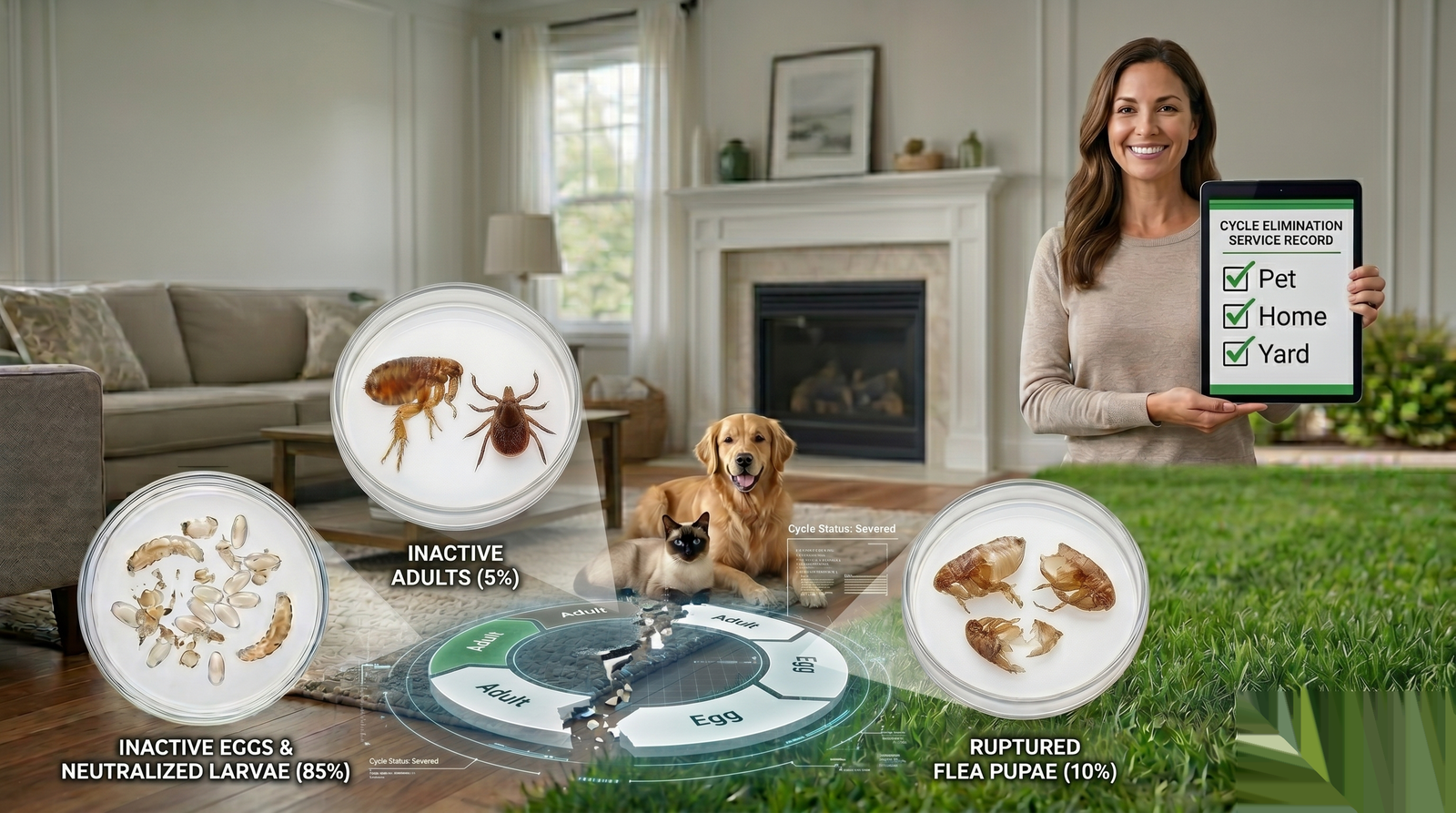
Laid on pets but immediately fall off into carpet, furniture, and soil. Hatch in 2–14 days. Resistant to most treatments.
Live deep in carpet fibres and soil. Feed on flea dirt. Avoid light — burrow deep. Last 5–18 days.
Inside a sticky cocoon impervious to most insecticides. Can remain dormant for months until a host vibration triggers emergence.
The only stage visible on your pet. Feed every 2–3 hours. Begin laying eggs within 24 hours of first meal.
The critical fact: Treating only your pet with flea products kills adults — but leaves 95% of the infestation (eggs, larvae, and pupae) in your home and yard, ready to hatch new adults within days. Complete elimination requires simultaneous treatment of the pet, the indoor environment, and the yard.
Our technicians treat both — but the approach, targeted areas, and prevention advice differ significantly. Understanding each pest helps you know what to expect from professional treatment.
Despite the name, the cat flea is the species that infests dogs, cats, and humans across Northern California — and it is by far the most common flea found in homes throughout Lake, Mendocino, and Sonoma Counties. They are visible jumping insects (1–3mm), reddish-brown, laterally flattened, and capable of jumping 150 times their own body length to reach a host. A single pair begins producing eggs within 24 hours of the first blood meal and can generate 2,000 offspring in 60 days.
Flea pressure in Lake, Mendocino, and Sonoma Counties is year-round — mild winters mean fleas never fully die off outdoors. Properties near wildlife corridors (deer, raccoon, and opossum are major flea hosts), oak woodland, and rural grassland face significantly higher flea pressure. Outdoor pet runs, deck areas, and shaded garden beds are the primary outdoor harborage zones in our service area.
Northern California has two primary tick species of concern: the Western black-legged tick (Ixodes pacificus) — the primary vector for Lyme disease in California — and the Pacific Coast tick (Dermacentor occidentalis), which transmits Rocky Mountain spotted fever, anaplasmosis, and other pathogens. Both species are found throughout Lake, Mendocino, and Sonoma Counties, with the Western black-legged tick particularly prevalent in moist woodland and shrubland environments near Clear Lake and along the Mendocino coast.
Tick pressure is highest in properties bordering woodland, chaparral, and tall grass — common throughout rural Lake and Mendocino Counties and the Sonoma wine country. Properties near deer trails face significantly elevated tick risk. The Western black-legged tick is found throughout the coastal and inland hill zones — the exact environments common around Lakeport, Kelseyville, Willits, Healdsburg, and the Mendocino ridge.
Pet-only treatment never works. Flea and tick elimination requires simultaneous treatment of every habitat — pet, indoor environment, and yard perimeter — in a single coordinated service.
We treat every indoor environment where fleas exist in their immature stages — not just the surfaces where adults are seen. Targeted application to carpets, rugs, furniture bases, pet bedding areas, and under furniture where larvae and pupae accumulate. IGR (insect growth regulator) breaks the reproductive cycle by preventing eggs and larvae from developing into reproducing adults. Adulticide eliminates active adults. Combination treatment eliminates all life stages simultaneously.
Outdoor treatment creates a tick-free perimeter around your property and eliminates the outdoor flea population that continuously reinfests your home and pets. We target the areas where fleas and ticks concentrate — shaded garden beds, under decking, along fence lines, overgrown borders, and moist leaf litter areas. For tick control, we focus on the transition zones between lawn and vegetation where ticks wait in questing position for hosts.
A coordinated 5-step process that covers every environment, every life stage, and gives you clear guidance for before and after treatment to maximise effectiveness.
We inspect indoor hot spots (carpets, pet areas, furniture) and outdoor zones (shaded beds, deck, borders). We identify severity, species present, and all treatment areas.
We provide a clear checklist — vacuum carpets, wash pet bedding, treat pets with vet-approved product simultaneously. Preparation is critical for maximising treatment outcome.
IGR and adulticide applied to carpets, furniture bases, skirting boards, and all pet resting areas. Reaches larvae and pupae deep in carpet fibres where they live.
Targeted spray to shaded lawn, garden beds, under decking, fence lines, and vegetation borders. Creates a treated perimeter preventing outdoor re-infestation of home and pets.
We advise on post-treatment vacuuming protocol (triggers pupae to emerge into treated areas). Follow-up if activity persists. Full satisfaction guarantee on every service.
Unlike colder climates, Northern California's mild winters mean fleas and ticks never fully die off. Knowing when pressure peaks helps you protect your family and pets year-round.
Our flea and tick treatments use IPM-based products selected specifically for safety around pets and children. We use IGR formulations that affect only insects — safe for mammals. Outdoor treatments are applied with pollinators in mind, avoiding flowering plants. Safe for Clear Lake, the Russian River, and Northern California's sensitive ecosystems.
We treat every stage — eggs, larvae, pupae, and adults — simultaneously in a single coordinated service. IGR (insect growth regulator) breaks the reproductive cycle, preventing surviving pupae from developing into reproducing adults. This is what separates lasting elimination from temporary reduction that resets in 3 weeks.
We treat the indoor environment AND the yard in the same service visit — the only approach that actually works. Treating just the house leaves the outdoor source intact. Treating just the yard leaves the existing indoor population to continue cycling. Complete coverage breaks both sides of the infestation simultaneously.
Every product we use for flea and tick treatment is selected with pets and children as the primary safety consideration. We use IGR-based formulations that affect insect development — not mammalian biology. We provide specific post-treatment guidance for pets including re-entry times and areas to avoid while products dry.
Our technicians know which tick species are active in which specific areas of Lake, Mendocino, and Sonoma Counties — Western black-legged tick distribution near Clear Lake, Pacific Coast tick in drier inland areas, seasonal patterns for each species. This local knowledge drives more effective targeted treatment than a generic regional approach.
If fleas or ticks return between scheduled visits, we come back and re-treat at no additional charge. Our guarantee is backed by the comprehensiveness of our treatment protocol — every life stage, every environment, every access point. Most clients achieve complete elimination after a single comprehensive service plus follow-up.
Flea infestations compound fast — a moderate problem becomes severe in 2–3 weeks without treatment. With offices in Lakeport, Windsor, Ukiah, and Fort Bragg, we can have a licensed technician at your property the Fast response in most areas. Call us before noon and we respond that afternoon.
Our locally-based technicians know the specific flea and tick pressures in your neighbourhood — from the lakeside flea seasons around Clear Lake to the Lyme-endemic tick zones of coastal Mendocino County.
Because only 5% of the flea population is on your pet at any time — the other 95% exists as eggs, larvae, and pupae in your carpets, furniture, pet bedding, and yard. Treating your pet eliminates the adult fleas on the animal but leaves the 95% in your environment intact. Those immature stages continue developing and produce new adults that re-infest your pet within days. Complete elimination requires treating the pet AND the indoor environment AND the yard simultaneously.
Yes — it is a documented, ongoing risk in Lake, Mendocino, and Sonoma Counties. The Western black-legged tick (Ixodes pacificus), which is the primary Lyme disease vector in California, is found throughout the region. The California Department of Public Health confirms Lyme disease cases from tick exposure in Northern California annually. The risk is highest in wooded areas, shrubland, and properties bordering wildlife habitat — exactly the environments common throughout our service area.
We typically ask all occupants — including pets — to vacate treated areas for 2–4 hours while products dry. Once dry, the treated areas are safe for re-entry. We provide specific post-treatment guidance during the service, including which areas were treated and the appropriate re-entry times for your household including children, dogs, and cats.
Preparation significantly improves treatment effectiveness. Key steps include: vacuuming all carpets and rugs thoroughly (dispose of the bag or empty the canister outdoors immediately), washing all pet bedding in hot water, treating all pets with a vet-approved flea product on the Fast response as our treatment, removing pets and children from treatment areas, and picking up any items from the floor that would prevent carpet access. We provide a detailed checklist during the inspection appointment.
Yes — once products have dried, which typically takes 2–4 hours. We use IPM-based, low-toxicity formulations including IGR (insect growth regulator) products that affect insect development mechanisms not present in mammals. We advise on specific re-entry times per area and which surfaces to avoid until fully dry. We also provide guidance for households with puppies, kittens, senior animals, or pets with known sensitivities.
This is more common than most people expect. Common introduction routes for indoor-only pet households: flea eggs and larvae carried in on clothing, shoes, or bags after contact with infested environments; visiting animals bringing fleas indoors; fleas entering through gaps around doors and ground-level vents from yard wildlife (raccoons, opossums); and occasionally, new furniture or used items from infested properties. Fleas don't need a pet to survive — they will feed on humans.
Perform a full-body check after spending time outdoors — ticks are most commonly found in warm, moist areas: behind the ears, the scalp, back of the neck, armpits, groin, behind knees, and between toes. Check children and pets thoroughly. The nymphal Western black-legged tick is the size of a poppy seed — very easy to miss. Lyme transmission requires 24–36 hours of attachment, so daily checks after outdoor activity significantly reduce disease risk.
Yes — vacuuming regularly after flea treatment is actually recommended. Vacuuming creates vibration that stimulates dormant flea pupae to emerge from their cocoons into the treated environment, where the residual product then kills them. Pupae are the most resistant flea stage — impervious to insecticides inside their cocoons. Post-treatment vacuuming every 1–2 days for the first 2 weeks dramatically accelerates complete elimination by triggering pupae to hatch into the treated zone.
Prompt scheduling and fast service available across all four offices. A locally-based technician will assess your indoor and outdoor environments and present a complete treatment plan — before treating anything.
All our flea and tick products are selected for pet and child safety. We use IPM-based IGR formulations safe for dogs, cats, and all household animals. You never have to choose between effective treatment and a safe home.